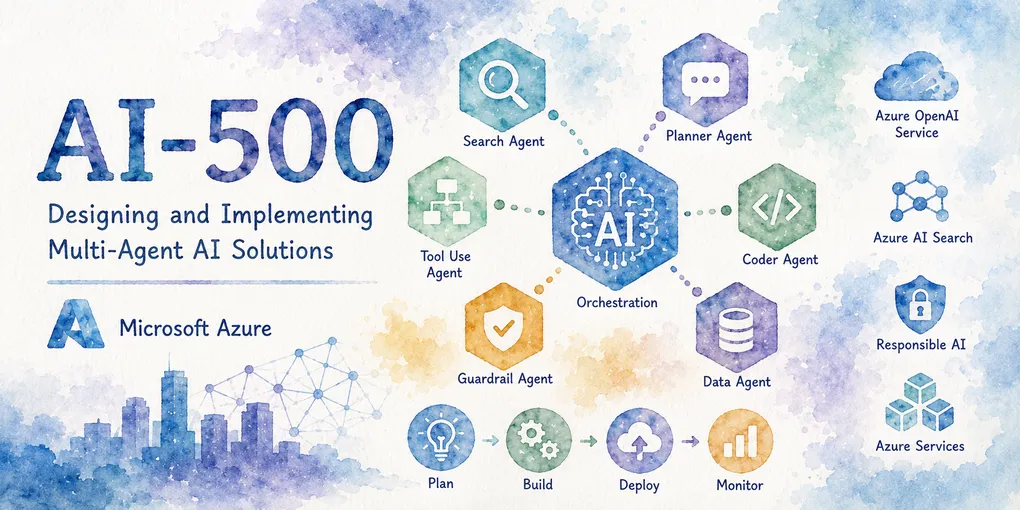
What Is AI-500? Exam Scope, Differences from AI-103, and How It Compares with Other Certifications
⚠️ Information in this article is current as of August 17, 2026. AI-500 is still in beta, so the exam scope, pricing, and general availability timeline may change. Be sure to check the official Microsoft Learn exam page before scheduling your exam.
Hello, and welcome to Lena Nadir Blog.
About a month ago, I wrote about my experience passing AI-103: Azure AI Apps and Agents Developer Associate. Now Microsoft has introduced another certification positioned one level above AI-103: AI-500: Designing and Implementing Multi-Agent AI Solutions, currently available in beta.
I have not taken the exam yet. Beta exams come with their own constraints, including limited discount periods and timing considerations, so I am still deciding when to take it. Still, even from the official Study Guide and early reactions online, Microsoft’s direction for its AI agent certification portfolio is becoming surprisingly clear.
This article is therefore partly a research note for my own preparation, but also an attempt to organize what we currently know about AI-500.
🎓 What Is AI-500? Microsoft’s First Expert Certification Focused on Multi-Agent AI
Passing AI-500: Designing and Implementing Multi-Agent AI Solutions contributes toward earning the Microsoft Certified: Multi-Agent AI Solutions Expert certification.
It is Microsoft’s first Expert-level certification specifically focused on production-grade multi-agent systems within its AI certification portfolio.
I already hold AI-103 and have been working with AI agent development myself, so when Microsoft puts the words “Multi-Agent AI Solutions Expert” directly into the certification name, it is difficult not to want to take the challenge.

As of August 2026, here is what we know:
- Status: Currently available as a beta exam. Microsoft has not announced a specific date for general availability as of August 2026. The related official training course, AI-500T00-A, is scheduled to become available on September 30, 2026.
- Passing score: 700 out of 1,000
- Exam duration: Check the scheduling page when booking. Microsoft Expert exams without labs commonly provide around 100 minutes of answering time, with approximately 120 minutes total including instructions and administrative steps.
- Exam price: The standard US-listed price is $165. Pricing varies by country and region, so candidates in Japan should confirm the actual fee during scheduling. The 80% beta discount previously offered applied to exams taken by August 5, 2026 and has already expired at the time of writing.
- Practice Assessment: Not yet available during the beta phase.
As shown in the certification path above, earning Microsoft Certified: Multi-Agent AI Solutions Expert requires both the prerequisite Microsoft Certified: Azure AI Apps and Agents Developer Associate certification and a passing score on AI-500.
⚠️ Note: The prerequisite applies to earning the Expert certification itself. It does not necessarily mean you must already hold the prerequisite certification before you can schedule or take AI-500. You may be able to take AI-500 first, but you will still need to complete the prerequisite certification before earning the Expert credential.
AI-103 vs. AI-500
As discussed in more detail below, AI-500 is essentially a certification for solution architects in the AI agent space, testing the knowledge required to design and operate multi-agent systems in production environments.
| Perspective | AI-103 | AI-500 |
|---|---|---|
| Skills evaluated | Designing and implementing AI applications and agents primarily with Microsoft Foundry | Designing, building, and optimizing production-grade multi-agent systems |
| Main scope | Models, RAG, Tool Calling, single-agent systems | Orchestration, shared state, evaluation, monitoring, governance |
| Target audience | Developers / AI Engineers building AI applications and agents with Microsoft Foundry | AI Engineers / Solution Architects deploying multi-agent systems into production |
| Certification relationship | Prerequisite certification for the Expert credential | Exam required for the Expert credential |
📊 What the Study Guide Reveals About the Exam
According to the official AI-500 Study Guide, the exam is divided into four domains:
| Domain | Weight |
|---|---|
| Architect multi-agent solutions | 15–20% |
| Develop multi-agent solutions on Azure | 30–35% |
| Evaluate, optimize, and monitor multi-agent solutions | 20–25% |
| Secure, govern, and deploy multi-agent solutions | 20–25% |
My summary and interpretation of the official Audience Profile would be something like this:
An expert-level practitioner with experience designing, building, and optimizing scalable multi-agent AI systems and workflows for production environments. The role spans the lifecycle from architecture to production and involves working with developers, machine learning engineers, platform engineers, data scientists, and business stakeholders to translate complex requirements into production-ready multi-agent solutions.
This certification is for people who architect AI systems for production.
AI-103 focuses primarily on implementing individual AI applications and agents. AI-500 goes a step further, emphasizing how multiple agents should be orchestrated in production, how much autonomy should be delegated to LLMs, and where deterministic system control should remain.
Adding more agents does not automatically make a system more intelligent. Even highly capable agents can fail to produce the expected outcome if their roles and coordination are poorly designed. As the number of agents grows, orchestration becomes increasingly important: how the team operates matters more than the capabilities of any individual agent.
To use a deliberately rough football analogy, the philosophy feels less like Brazil, where individual creativity is often emphasized, and more like Spain, where positioning, roles, and coordinated movement operate within a highly structured system.
Several topics in the Study Guide particularly stood out to me:
- Enterprise-oriented Zero Trust architecture: Topics such as per-agent identity scoping and lateral movement prevention appear explicitly in the scope. These are security concerns that rarely appear when implementing a single agent. Zero Trust has long been a major theme across Microsoft 365 and Entra ID, and AI-500 effectively brings that philosophy into the world of agent operations.
- Detailed memory and context architecture: The exam goes beyond simply implementing RAG. It covers separation of short-term and long-term memory, session state versus shared team state, and the accumulation, retrieval, injection, and compaction of context.
- Broad coverage of orchestration patterns: The Study Guide explicitly includes hub-and-spoke, sequential, parallel, peer-to-peer, and orchestrator-subagent patterns. Candidates are expected to understand implementations across Microsoft Agent Framework, LangChain, and LangGraph.
- Strong emphasis on observability and incident response: Correlation IDs for traces, detection of agent behavioral drift, and agent replay for reproducible debugging are all examples of production-oriented concepts. Evaluation, optimization, and monitoring alone account for 20–25% of the exam.
- LLM-as-a-judge and AI Red Teaming Agent: The fact that AI systems are already being used both to evaluate and attack other AI systems—and that these techniques are now explicitly included in certification objectives—reflects how quickly production AI practices have evolved by 2026.
The weight given to security, governance, and CI/CD is clearly greater than in AI-103.
In AI-103, CI/CD integration and Responsible AI implementation are only part of the broader “Plan and manage an Azure AI solution” domain, which accounts for 25–30% of the exam.
AI-500, by contrast, dedicates an entire domain—“Secure, govern, and deploy multi-agent solutions”—to these topics, representing 20–25% of the exam. It explicitly includes CI/CD requirements involving Infrastructure as Code and shift-left security using AI Red Teaming Agents.
Looking back at my previous AI agent framework comparison article, AI-500 seems to require knowledge across both the Framework / SDK layer and the Platform / Runtime layer.
It is not enough to understand implementation using Microsoft Agent Framework at the framework layer. Candidates also need to understand how Microsoft Foundry Agent Service handles operations, monitoring, deployment, and governance at the platform layer.
💬 Early Reports on Reddit: Long Scenario-Based Questions May Be the Real Challenge
I came across a Reddit post titled AI500 MultiAgents Expert was very difficult for me.
According to the author, the beta exam consisted of 65 questions and two case studies. They described many questions as lengthy and said that some answer choices differed only slightly, making the exam mentally demanding.
At the same time, another candidate in the comments said the exam was difficult but that only about one question had genuinely left them uncertain.
We obviously cannot determine the overall difficulty of the exam from a handful of self-reported experiences.
However, one theme does emerge from these early reports:
The cognitive load of reading long scenarios and distinguishing between very similar architectural choices may be one of the most challenging aspects of AI-500.
🤖 A Quick Review of Multi-Agent Systems
Google Cloud’s Architecture Center distinguishes between single-agent and multi-agent architectures.
A single-agent system uses one AI model together with a collection of tools to autonomously perform tasks. In many cases, this is the recommended starting point.
A multi-agent system, by contrast, decomposes a larger objective into smaller subtasks and assigns them to specialized agents that collaborate through coordinated or hierarchical structures.
This can improve scalability and maintainability, but it also introduces additional challenges around access control, orchestration, state management, and cost.
Mapping the orchestration patterns described by Google Cloud to those listed in the AI-500 Study Guide produces roughly the following comparison:
| Google Cloud pattern | Overview | Corresponding AI-500 pattern |
|---|---|---|
| Sequential | Agents execute one after another in a predefined sequence | Sequential |
| Parallel | Multiple specialized agents execute independently at the same time before their outputs are combined | Parallel |
| Coordinator | A central coordinator analyzes tasks and dynamically routes work to specialized agents | Hub-and-Spoke |
| Hierarchical Task Decomposition | A root agent decomposes complex tasks into multiple levels and delegates them through a hierarchy | Orchestrator-subagent |
| Loop / Review & Critique / Iterative Refinement | Generation, evaluation, and improvement repeat until a termination condition or review criterion is satisfied | Covered partly through Human-in-the-Loop concepts |
AI-500 additionally includes patterns such as Handoff, where control passes between agents, and Peer-to-Peer, where agents interact as equals.
The classifications do not map perfectly between Microsoft and Google Cloud, but the underlying architectural ideas are largely shared.
🧩 Does AI-500 Also Test Framework Selection?
Microsoft Learn training for AI-500 includes a unit titled Compare orchestration frameworks.
It compares four major Python-based multi-agent orchestration frameworks in 2026:
- Microsoft Agent Framework / Semantic Kernel
- LangGraph
- AutoGen
- CrewAI
This lineup itself tells us something important.
AI-500 does not appear to be an exam that simply asks whether you know the APIs of a particular SDK.
Instead, it seems to reach into a broader question:
What kind of agentic system are you trying to build, and which framework should you choose to build it?
As a representative example, the following diagram summarizes the differences between LangGraph, which I also use frequently, and Microsoft Agent Framework.
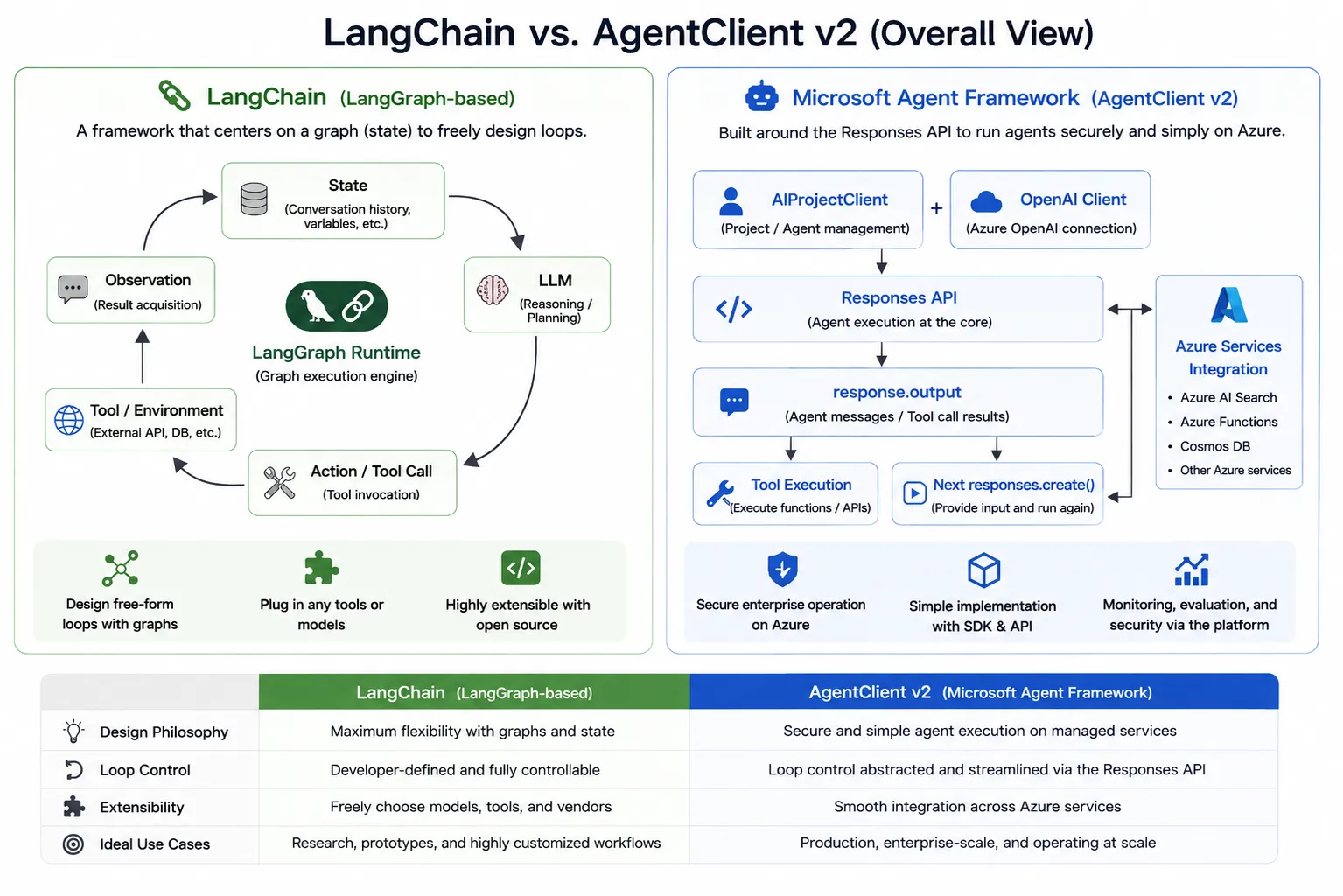
Diagram generated with an LLM and reviewed by the author: LangChain/LangGraph vs. Microsoft Agent Framework (AgentClient v2)
Both LangGraph and Microsoft Agent Framework provide ways to combine probabilistic agent reasoning with execution flows explicitly defined by developers.
Their design philosophies, however, differ.
LangGraph builds workflows around State and Graph-based state transitions.
That makes it relatively straightforward to explicitly represent complex orchestration patterns involving branching, loops, parallel execution, retries, and Human-in-the-Loop interactions.
Microsoft Agent Framework, on the other hand, emphasizes consistency when building and operating agents on Microsoft’s AI platform, including integration with Microsoft Foundry and other Azure services.
That said, reducing the comparison to:
“LangGraph offers flexibility, while Microsoft Agent Framework offers managed services”
would be too simplistic.
The more important question is:
How much decision-making should be delegated to agents, and where should the system itself retain control?
You also need to consider where you want complexity to live across state management, observability, security, and integration with your existing cloud environment.
For a deeper discussion of the difference between these layers, see my previous AI agent framework comparison article.
And once we move into multi-agent systems, this architectural decision becomes even more important.
Adding two, three, or ten agents does not increase system capability in direct proportion to the number of agents.
Instead, it also increases the coordination complexity caused by dependencies between agents, shared state, failure behavior, and execution costs.
This leads to one of the most important architectural questions in production agentic systems:
Where should we draw the boundary between decisions delegated to the LLM and execution controlled deterministically by the system?
The strength of an LLM is its ability to interpret ambiguous situations and make flexible decisions based on context.
But if every decision is delegated to the LLM, then even the execution path itself becomes probabilistic.
That makes reproducibility, cost control, safety, and debugging considerably harder to manage.
This is why production agentic systems increasingly depend on the combination of:
Probabilistic Intelligence × Deterministic Orchestration
Give agents the freedom to think.
But let the system decide how much freedom they are allowed to have.
The more I read through the AI-500 Study Guide and training material, the more it seems that Microsoft does not view multi-agent systems simply as “multiple LLMs connected together.”
Instead, it treats them as an architectural problem:
How do we turn multiple probabilistic agents into a production system that behaves predictably enough to operate safely and reliably?
⚖️ Comparing AI-500 with AWS, Google Cloud, and NVIDIA Certifications
Agentic AI is not a Microsoft-only trend.
AWS, Google Cloud, and NVIDIA are also beginning to incorporate agentic AI into their certification portfolios.
However, they are positioning it in noticeably different ways.
The key distinction is whether a certification is narrowly specialized around Agentic AI, or whether agentic systems are treated as one component within a broader Generative AI or Machine Learning curriculum.
Comparing representative certifications makes those platform strategies easier to see.
| Certification | Primary focus | Main characteristics and scope |
|---|---|---|
| Microsoft AI-500 | Multi-agent systems | Orchestration, state management, evaluation, monitoring, security |
| AWS AIP-C01 | Generative AI applications | Broad coverage of FMs, RAG, Agentic AI, governance, and production operations |
| Google Cloud PMLE | ML / Generative AI platform engineering | Broad coverage across ML, data, MLOps, and Generative AI |
| NVIDIA NCP-AAI | Agentic AI | Specialized focus on agent design, multi-agent systems, evaluation, and deployment |
AWS: Generative AI Developer - Professional
The closest AWS equivalent is AWS Certified Generative AI Developer - Professional (AIP-C01).
It covers production-grade generative AI applications broadly, including Foundation Model integration, RAG, Agentic AI, safety, governance, evaluation, monitoring, and cost and performance optimization.
Where AI-500 narrows its focus specifically to multi-agent systems, AIP-C01 takes a broader perspective and evaluates the ability to build and operate generative AI applications on AWS in production.
Google Cloud: Professional Machine Learning Engineer
On Google Cloud, the closest technical certification is Professional Machine Learning Engineer.
The current exam goes beyond traditional machine learning and now includes Foundation Models, Generative AI, Agent Platform, evaluation, and monitoring.
However, it remains a broad certification that also covers data platforms, ML pipelines, and MLOps.
It is not specifically focused on multi-agent systems.
NVIDIA: Agentic AI Professional
A certification much closer to AI-500 in scope is NVIDIA-Certified Professional: Agentic AI (NCP-AAI).
It focuses specifically on Agentic AI, including agent design, multi-agent collaboration, evaluation, monitoring, deployment, and governance.
The exam consists of approximately 60–70 questions over 120 minutes and is currently available.
AI-500 and NCP-AAI therefore occupy relatively similar specialist territory.
AWS and Google Cloud, by contrast, position Agentic AI as one component of a broader Generative AI or ML platform skill set.
Whether a certification specializes deeply in Agentic AI or treats it as one part of the broader AI system stack also reveals something about each vendor’s overall AI platform strategy.
🗺️ A Learning Roadmap for AI-500
Rather than trying to memorize the entire exam scope horizontally from the beginning, I think it makes more sense to build knowledge in the following sequence:
- AI-103-level foundations: Models, RAG, Tool Calling, single-agent systems, Microsoft Foundry
- Communication and interoperability: MCP, A2A, tool ecosystems, agent-to-agent messaging
- Orchestration: Sequential, concurrent, handoff, hub-and-spoke, supervisor patterns
- State and Memory: Sessions, shared state, long-term memory, compaction, checkpoints
- Evaluation and Observability: LLM-as-a-judge, traces, replay, drift, cost, latency
- Production operations: Identity, permission isolation, Zero Trust, governance, deployment, disaster recovery
Viewed in this order, AI-500 starts to look much less like an exam about memorizing individual SDKs.
Instead, it resembles a structured body of knowledge around one larger question:
How do you make agents work as a real production system?
🏁 Conclusion: Should You Take AI-500 Now?
Based on what we know today, AI-500 seems particularly worth considering for people who:
- Want to earn the Expert certification and already hold the prerequisite Azure AI Apps and Agents Developer Associate
- Have hands-on experience building multi-agent systems with Microsoft Agent Framework, LangGraph, MCP, or A2A
- Are comfortable with the uncertainty that comes with taking a beta exam while public information is still limited
I have not taken AI-500 yet myself, but I plan to take it and publish a follow-up article covering my actual preparation strategy and perceived exam difficulty.
References
- Study guide for Exam AI-500: Designing and Implementing Multi-Agent AI Solutions (Microsoft Learn)
- Exam AI-500: Designing and Implementing Multi-Agent AI Solutions (beta) (Microsoft Learn)
- Microsoft Certified: Multi-Agent AI Solutions Expert (beta) (Microsoft Learn)
- New Microsoft Certified: Multi-Agent AI Solutions Expert Certification (Microsoft Community Hub)
- AI500 MultiAgents Expert was very difficult for me (r/AzureCertification)
- Choose a design pattern for your agentic AI system (Google Cloud Architecture Center)
- Compare orchestration frameworks (Microsoft Learn Training)
- Microsoft Agent Framework Overview (Microsoft Learn)
- Microsoft Agent Framework Workflows (Microsoft Learn)
- Quickstart: Build agents using the Responses API (Microsoft Learn)
- AWS Certified Generative AI Developer - Professional Exam Guide (AWS)
- Professional Machine Learning Engineer (Google Cloud)
- NVIDIA-Certified Professional: Agentic AI (NVIDIA)